
Best AI Business Platforms for SMEs in 2026
There are now dozens of AI business platforms, and they do different jobs; this is how to tell the types apart, and choose the one that fits the problem you actually have.
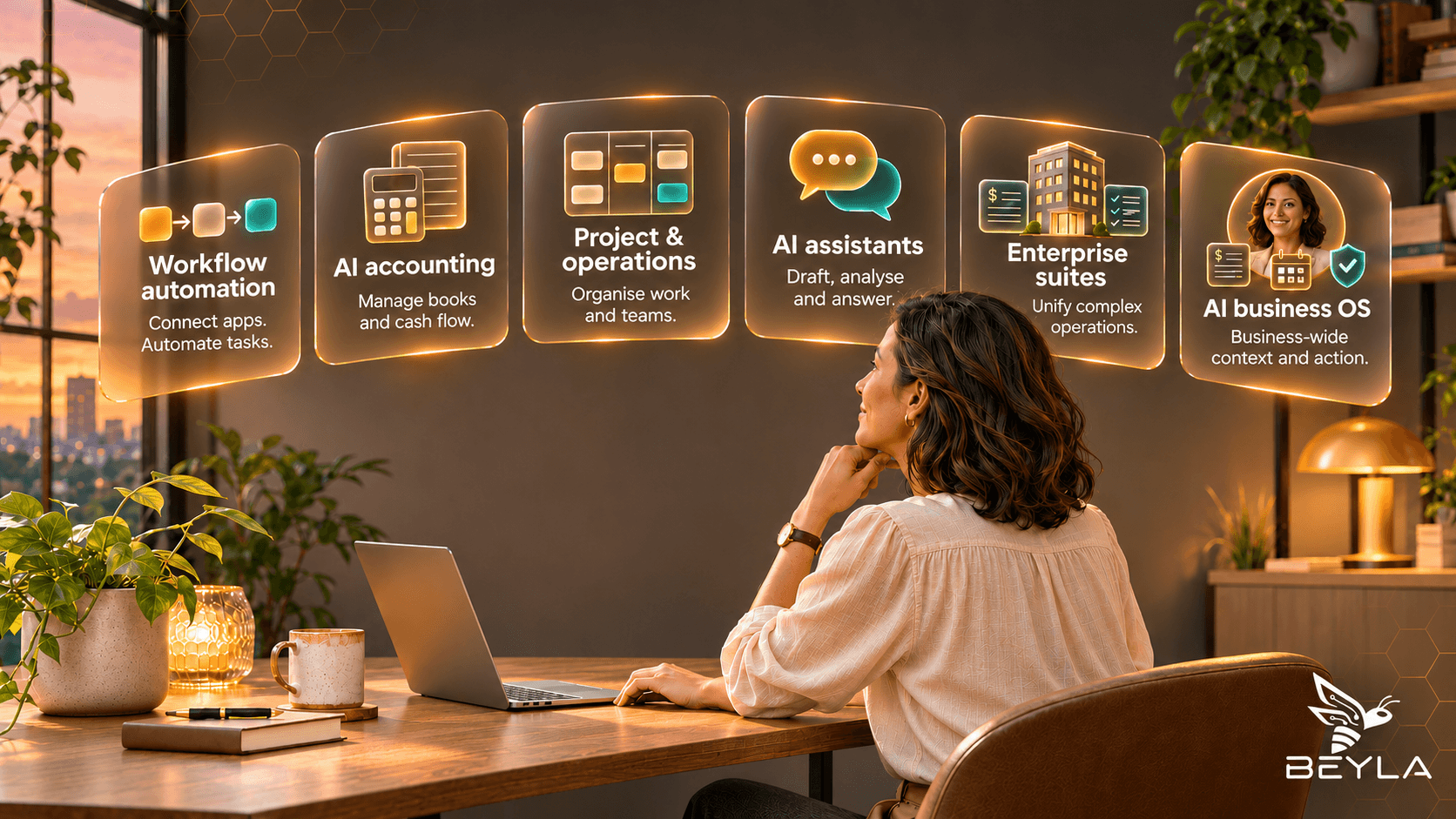
There are now dozens of AI business platforms, and they do different jobs; this is how to tell the types apart, and choose the one that fits the problem you actually have.
Catherine Sin
Co-Founder, BEYLA
Search "AI business platform for SMEs" and you will drown in options within a minute. Workflow builders, AI-enhanced accounting, project tools, assistants, all-in-one suites – each calling itself the answer.
The confusion is understandable, because the label is doing too much work. These tools are not variations on one thing. They are different categories, solving different problems, and the fastest way to waste money is to buy the wrong type well rather than the right type at all.
This guide is a chooser, not a ranking. It sets out the main types of AI business platform for SMEs, the decision criteria that actually separate them, and how to match a type to the problem in front of you. If your underlying issue is that your existing tools do not talk to each other, that is a different question – software sprawl – and we cover it in our guide to centralising your business software. This piece is about picking the right kind of platform in the first place.
Key takeaways
- "AI business platform" covers at least six different categories, from single-task automation to platforms that read across the whole business.
- They are not direct competitors – they do different jobs, so the right choice depends on the problem you are solving.
- The criteria that separate them are context, proactivity, memory, explainability and control – not feature counts.
- Most SMEs start with one or two types and add a broader platform as the cost of connecting tools grows.
First, the decision criteria
Before any names, decide what you are actually judging. These are the questions that separate a platform that fits from another subscription you half-use:
- Scope – does it do one task, one function, or read across the whole business?
- Context – does it understand how your business works, or execute in isolation?
- Proactivity – does it bring things to your attention, or wait to be asked?
- Memory – does it remember your business, or start cold each time?
- Explainability – can you see why it recommends something, traceable to real data?
- Control – who makes the decision, you or the tool?
- Fit – is it built and priced for a business your size, not scaled down from an enterprise product?
- Trust – is it secure, consent-based and auditable?
Hold any platform against those eight and the marketing noise clears quickly. The rest of this guide maps the categories onto them.
The six types of AI business platform for SMEs
1. Workflow and automation builders
Tools such as Zapier, Make and n8n connect apps and automate repetitive steps without code – move data from a form to a spreadsheet, trigger an email when a deal closes, sync records between systems.
- Best for: removing specific, repetitive manual tasks.
- The trade-off: you design and maintain the logic. They execute rules you set; they do not understand your business, and every workflow you add is one more thing to keep running.
2. AI-enhanced accounting and finance
Platforms like Xero, QuickBooks and Sage now bundle AI that categorises transactions, reconciles the bank, chases invoices and eases month-end.
- Best for: keeping the books clean and compliant, including Making Tax Digital.
- The trade-off: the view is financial and largely backward-looking. It tells you what happened to the money, not why, and not what is happening across the rest of the business. (For the finance-specific picture – and where an "AI CFO" helps and stops – see our guide to AI CFOs for SMEs.)
3. Project and operations management
Monday, Asana, ClickUp and Notion organise work, tasks and teams, with AI increasingly added to summarise, assign and flag risk. Field-service businesses often use job-management tools such as Jobber.
- Best for: coordinating people and work.
- The trade-off: they manage the doing, but sit apart from finance and customer data. The work and the money stay in separate places.
4. AI assistants and copilots
General-purpose assistants – ChatGPT, Claude, Microsoft Copilot, Google Gemini – draft, analyse and answer, and increasingly live inside the tools you already use.
- Best for: flexible, on-demand help with words, numbers and ideas.
- The trade-off: they are general by design. Most hold no persistent memory of your business, so you supply the context each time, and they act within one conversation rather than across your operations.
5. All-in-one enterprise suites
Enterprise platforms such as SAP and Oracle NetSuite genuinely unify finance, operations and more into one system.
- Best for: larger organisations with the teams to run them.
- The trade-off: built and priced for big companies, heavy to implement, and usually far too much for a business of ten or twenty people.
6. AI business operating systems
The newest category, and a different idea: rather than automate one lane or digitise one function, these platforms aim to understand the business as a whole and act across it, with the owner in control. BEYLA sits here – more below.
How the types compare
Each does its own job well. The difference is scope and context, not quality.
| What matters | Workflow builders | AI accounting | Project / ops | AI assistants | Enterprise suites | AI business OS |
|---|---|---|---|---|---|---|
| Scope | One task | Finance | Work | Anything, one chat | Whole business | Whole business |
| Understands context | No | Finance only | Work only | Per conversation | Yes, if configured | Yes |
| Proactive | Rules you set | Some alerts | Some alerts | No, you prompt | Varies | Yes |
| Remembers your business | No | Some | Some | Rarely | Yes | Yes, via the Hive |
| Built for SME size | Yes | Yes | Yes | Yes | No | Yes |
Which type should you choose?
Match the type to where the pain is sharpest today:
- Drowning in repetitive admin? A workflow builder pays for itself fastest.
- Month-end and cash visibility the problem? Lean on the AI in your accounting platform, or an AI CFO layer above it.
- Work slipping through the cracks? A project or ops tool.
- Need flexible thinking help? An assistant.
- A large, complex organisation with teams to run it? An enterprise suite.
- The problem is that none of the above see each other – and you are the one joining them up? That is the case for an AI business operating system.
The honest guidance: start where it hurts most. Just choose knowing that every tool you add is another lane to connect – and at some point the effort of connecting them outweighs what any single one saves.
Where BEYLA fits
BEYLA is the first AI-native business and finance operating system, built for small and medium businesses – the sixth category above. Rather than another tool in one lane, it understands the business as a whole.
You work with one Digital Human – by voice, video or text – supported by specialist Digital Human workers across finance, operations, risk, Marketing and more, all drawing on the Hive, BEYLA's living memory of how your business runs. It connects to the tools you already use rather than replacing them, to surface what matters rather than wait to be asked, and to keep every recommendation explainable and traceable to real data. BEYLA prepares and explains; you decide.
It even answers the phone. BEYLA Voice acts as a receptionist on your line, but unlike a standalone answering service it works from the same shared memory as the rest of the business – so a caller, an invoice and a delivery promise sit in one place, not in four separate tools. That is what makes it an operating system for a small business, rather than another bolt-on.
Isn't that just an ERP?
It is the obvious question, because an ERP also claims to span the whole business. The difference is worth being precise about.
An ERP is a system of record: a place your data lives that you and your team operate. BEYLA is an intelligence layer that works across the systems you already have, including your ERP. It never asks you to rip out or replace what works. Its Digital Human workers integrate and talk directly to your existing systems, draw insight across them, and prepare the next step for your approval – you stay in control of every decision.
Put simply: BEYLA doesn't replace your system of record. It is the intelligence layer that works across it – and across the other tools in this guide – so the whole stack finally makes sense together, rather than each part knowing only its own corner.
BEYLA has participated in the FCA's inaugural Supercharged Sandbox and the Smart Data Accelerator SME Finance TechSprint.
For the fuller case on bringing a fragmented stack together, see How UK SMEs can centralise their business software in 2026. For the finance-leader view, see AI CFO for SMEs: what it does and why a Digital C-Suite goes further.
Frequently asked questions
What is an AI business platform for SMEs?
It is a broad label covering several different kinds of software: workflow automation, AI-enhanced accounting, project and operations tools, general AI assistants, enterprise suites, and AI business operating systems. They solve different problems, so "best" depends on which problem you are trying to solve.
What is the best AI business platform for a small business?
Different categories do different jobs. The right choice depends on where your time is going: automation for repetitive tasks, AI accounting for the books, project tools for coordinating work, assistants for flexible help, and an AI business operating system when the problem is that none of your tools see each other.
How do I choose between AI business platforms?
Judge them on scope, context, proactivity, memory, explainability, who stays in control, fit for your size, and security – rather than feature lists. Match the type to your sharpest problem first, and consider how much effort it will take to connect to the other tools you use.
Do I need several tools or one platform?
Most SMEs start with one or two types covering their most pressing problems. As a business grows, the effort of connecting those tools – and holding the whole picture together – can outweigh the time each one saves. That is the point at which a single platform built around shared business context becomes worthwhile.
What is an AI business operating system?
It is a platform designed to understand a business as a whole and act across it, rather than automating one task or digitising one function. BEYLA is an example: one Digital Human to interact with, specialist Digital Human workers across finance, operations, risk and Marketing, all working from one shared memory of the business, with the owner in control of every decision.
Is BEYLA an ERP?
No – and the difference matters. An ERP is a system of record: a place your data lives that you and your team operate. BEYLA is an intelligence layer that works across the systems you already have, including your ERP. It never asks you to rip out or replace what works; its Digital Human workers integrate and talk directly to your existing systems, draw insight across them, and prepare the next step for your approval, with you in control of every decision. In short, BEYLA doesn't replace your system of record – it is the intelligence layer that works across it.
Want to see this in action?
Become a Founding Member to be first in line when BEYLA launches.