
One Digital Human. A whole team behind it.
Small business owners do not need another fleet of tools to manage; they need one trusted point of contact, with specialist expertise working behind the scenes.
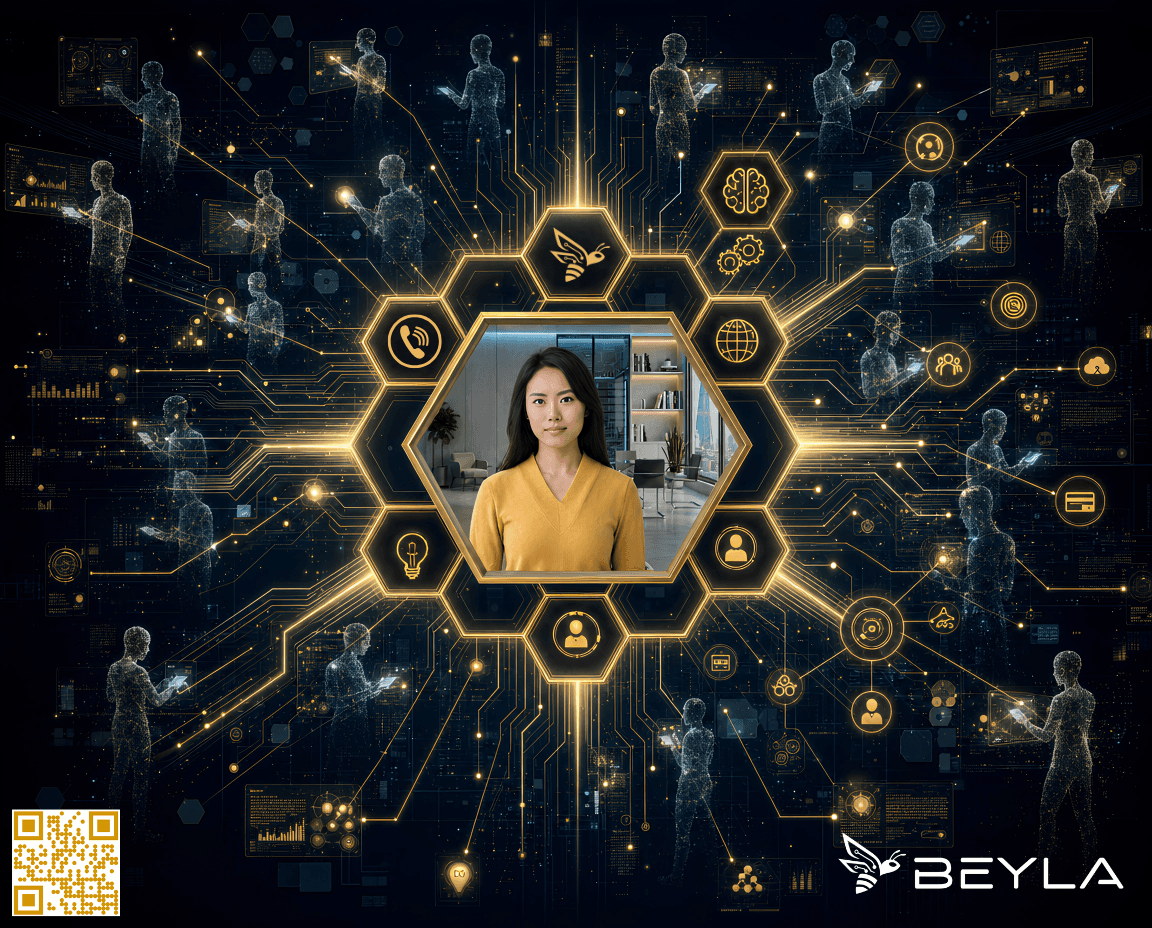
Small business owners do not need another fleet of tools to manage; they need one trusted point of contact, with specialist expertise working behind the scenes.
Daniel Callis
Founder and CEO
Whenever people imagine the ultimate AI assistant, they tend to imagine one presence. One Jarvis who understands the context, knows what matters and takes care of things without needing to be briefed from the beginning every time. That instinct is right.
Small business owners do not want ten more AI tools, ten separate assistants or another collection of systems they have to coordinate themselves. They want one point of contact who understands the whole business and can simply handle things. Where the popular vision falls short is not the one face. It is what sits behind it.
One relationship, not ten interfaces
The software industry’s answer to complexity has usually been another tool: one for the finances, one for sales, one for projects, one for Marketing and one for risk. Each may be useful in isolation. But the business owner is still expected to connect them, interpret what each one is saying and work out what it all means for the business as a whole.
The owner becomes the integration layer. AI risks repeating the same mistake. We could replace a fleet of tools with a fleet of assistants and leave the owner to manage the handoffs between them.
That is not less work. It is the same fragmentation with a more conversational interface. BEYLA is built around a different model: one relationship, with a whole team behind it.
Simplicity at the front. Specialism behind it.
One generalist can make the experience simple. But it cannot provide specialist depth across every business discipline on its own. With BEYLA, you choose one Digital Human to be your point of contact – the face, voice and presence you interact with through voice, video or message.
You talk to one. You do not manage ten. Behind that relationship sits a team of specialist Digital Human workers, with depth across finance, risk, operations, Marketing, sales and more.
When a question crosses several areas of the business, your Digital Human is designed to coordinate the relevant specialists, draw their thinking together and bring you one clear, joined-up answer. You never have to manage the handoffs. But the reasoning is not hidden from you. BEYLA is designed to explain what it has identified, why it matters and what requires your approval.
The simplicity of one assistant. The depth of an expert team. Not one or the other.
Real business questions rarely stay in one lane
Take a late customer payment. It may look like a finance issue. But it could also affect a supplier commitment, a hiring decision, the relationship with the customer and the confidence of the sales forecast.
A finance specialist may assess the effect on cash flow. Operations may identify which commitments could be affected. Sales may understand the customer context and whether the delay signals a wider risk.
The business owner should not have to open three systems, consult three different assistants and reconcile three separate answers. BEYLA is designed so that the Digital Human they already know can coordinate those perspectives and bring the issue back as one clear view:
- What changed?
- Why does it matter?
- What are the options?
- What decision is needed?
Thatisthedifferencebetweenreceivingmoreinformationandreceivingusefuljudgement.
The Hive is what holds it together
This model only works if every specialist draws from the same understanding of the business. That shared understanding is the Hive – BEYLA’s living memory of how each business works. With permission, the Hive connects the relevant context across systems, documents and previous decisions. It means every Digital Human can work from the same source of truth rather than reasoning from a separate dashboard or isolated fragment of data.
Without the Hive, a team of specialists could still produce a collection of disconnected opinions. The owner would be back to the oldest problem in business: the left hand not knowing what the right is doing.
With the Hive, the specialists can work as one. Without shared memory, proactivity is just more notifications. With shared memory, it becomes judgement.
From answering questions to noticing what matters
Most software waits to be opened. Most AI waits for a prompt. BEYLA is designed to bring what matters to the business owner before they know what to ask.
It can anticipate risks, surface opportunities and prepare the next action for approval. It is built to recognise when a change in one part of the business may affect another, then coordinate the appropriate specialist thinking behind the scenes.
The owner still has one relationship. But that relationship is supported by a wider understanding of the whole business.
You remain in control
Proactivity should not mean surrendering authority. BEYLA is designed to notice what matters, prepare the work and explain its thinking. The business owner makes the decision. Anything significant waits for their approval.
The point is not to replace the owner or pretend that software should run the business without them. It is to give them a team that answers to them.
Why this matters for small businesses
Large companies have always worked this way. A leader has specialist teams across finance, operations, risk, Marketing, sales and technology. Those teams coordinate behind the scenes and bring the leader the information and options needed to make a decision.
Small business owners have rarely had that support. They have been expected to occupy every seat themselves – finance director in the morning, operations lead by lunch and marketer by the time the day is done.
For small businesses, the future of work is not simply about automating more tasks. It is about putting joined-up expertise within reach of the people who have always had to carry every decision alone – and delivering it through one relationship simple enough to use.
The future of work
The future of work is not one clever assistant pretending to be an expert in everything. And it is not a pile of specialist tools or AI assistants that the owner is left to stitch together.
It is one face they trust, with a whole team of specialists behind it. One relationship. One shared understanding of the business.
Specialist depth when it is needed. And one owner who remains firmly in control. That is how the best-run businesses have always worked. The difference now is that this kind of support can finally be within reach of small businesses too.
BEYLA
Intelligence that acts for you.
Frequently asked questions
Do I deal with one AI or lots of them?
One. BEYLA is designed to let you choose a single Digital Human as your point of contact – the face and voice you interact with. Behind it, a team of specialist Digital Human workers provides the depth, coordinated through the Digital Human you already know.
What are Digital Human workers?
Digital Human workers are specialist members of your BEYLA team, each with depth in a different discipline such as finance, risk, operations, Marketing or sales. They work behind your chosen point of contact and draw from the same understanding of your business.
Why not use one general AI assistant for everything?
One general assistant can make the interaction feel simple, but business decisions often require specialist depth across several disciplines. BEYLA is designed to preserve the simplicity of one relationship while coordinating the appropriate specialist expertise behind it.
What is the Hive?
The Hive is BEYLA’s living memory of how your business works. With your permission, it connects information across your systems and documents so every Digital Human works from the same shared understanding and its guidance is grounded in your business rather than generic knowledge.
Does BEYLA make decisions on its own?
No. BEYLA is designed to anticipate what matters, prepare the work and explain its recommendations. You make the decisions, and anything significant waits for your approval.
Is BEYLA available today?
BEYLA’s intelligence layer is available to early members today.